Fire-watch coverage for warehouses that holds up to an AHJ visit at a DC.
Mission Protection Services staffs Cal/OSHA-compliant fire-watch for warehouses, distribution centers, and industrial facilities under our BSIS Private Patrol Operator license (PPO 126825). Dedicated licensed guard, hourly sweeps walked against your impairment map, and a permit-ready documentation pack on-site — same-day quote and same-day deployment inside the LA / OC / IE / SD / Riverside basin.
- Dedicated guard — never shared with another post
- Hourly sweeps tailored to your rack layout + impairment map
- Permit-ready log book with AHJ + site-contact signature lines
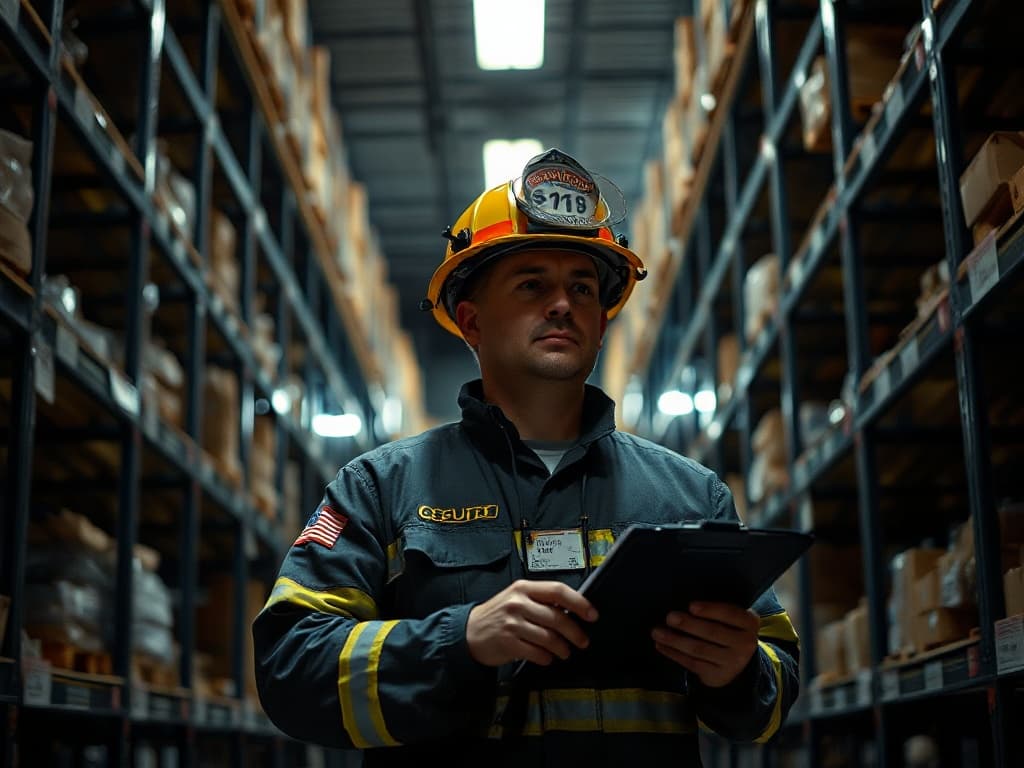
Where warehouse fire-watch actually bites
Three fire-watch triggers a generic plan won’t cover at DC scale.
A warehouse isn’t an open office. The geometry is bigger, the rack storage multiplies the worst-case fire load, and the Authority Having Jurisdiction expects the log book to map to your actual impairment — not a standard template. These are the three triggers our warehouse customers hit most.
Sprinkler / suppression impairment at scale
Ten or more sprinkler heads out of service, a closed system riser, an emptied fire pump, or a rack-dense rebuild that disables a zone perimeter. Large-footprint warehouses under NFPA 13 / NFPA 25 demand a guard whose sweep actually covers every impaired zone on a documented cadence — not a body pulled off a generic patrol route.
Hot work near palletized or rack storage
Welding, cutting, and brazing inside the building under a hot-work permit — Cal/OSHA Title 8 §6078 plus NFPA 51B. The risk isn’t the floor where the torch is running; it’s the vertical rack storage one aisle over, where ladder access to a hot spot is the problem hours after the cool-down window starts.
Open-floor and high-bay fire risk
Ceilings above 30 ft, vertical rack storage, conveyor / mezzanine cavities where detector coverage is by design partial. After a suppression-system trip or an impairment window, AHJ documentation is the difference between a clean close-out and a re-impairment that doubles the on-site guard hours on the next visit.
What we put on-site
A dedicated guard, hourly rack-row sweeps, a permit-ready log book, and dispatch waiting for the next AHJ call.
The same audit trail we built for armed and unarmed warehouse posts — GPS-stamped, time-carded, and downloadable from your dashboard the moment the watch ends. Written for warehouse and DC impairments, not retrofitted from an office-tower template.
Dedicated licensed guard on the impairment
A single guard on-site for the duration of the watch — same BSIS registration, Live Scan DOJ/FBI clearance, and current Power to Arrest training as every other MPS post. Under our BSIS Private Patrol Operator license (PPO 126825); never shared with another post, never drawn from a generic patrol roster.
Hourly perimeter + rack-row sweeps
A minimum of one sweep per hour walked against the impairment map — sprinkler zones, hot-work permit boundaries, post-incident boundaries, and the rack rows your AHJ flagged. Each sweep GPS-stamped and time-carded on the same platform as our armed and unarmed posts; an impairment map per area is part of the documentation pack.
Permit-ready documentation pack on-site
A printed log book on-site with date / time / initials per sweep, AHJ signature lines, site-contact signature lines, guard signature at start and end of watch, and a photographic note log during any hot-work or post-incident window. Countersignable by your site contact at end-of-watch; downloadable from your dashboard the moment the watch ends.
24-hour dispatch + supervisor on rotation
A real human answers our dispatch line at any hour. If a sweep is missed, the supervisor on rotation gets a notification — and your site contact gets a call within minutes, not at end-of-shift. The same rollout as our other warehouse and DC posts.
California Bureau of Security & Investigative Services Private Patrol Operator. In good standing since 2010.
Every rack-row and zone sweep GPS-stamped from the guard’s app, surfaced in your dashboard in real time. Cadence tightens around hot-work active periods and the post-incident cool-down window.
On-site printed log book with AHJ + site-contact signature lines, incident note log, and end-of-watch summary — exportable as a single zipped pack when your AHJ asks for the record.
Typical warehouse fire-watch pricing
Per-hour planning bands so the fire-watch team can quote on the first call.
These are typical bands — not a published contract. Your brief lands with the fire-watch team lead, who answers within one business day with a number specific to your footprint, rack layout, impairment type, and duration.
Single guard · business hours
$$/hr
Daytime impairments with a clear perimeter — sprinkler-system outages inside a single shift, hot-work on a permit during operations, post-incident windows during business hours when the building is partially staffed.
Single guard · overnight / weekend
$$/hr
Overnight or 24-hour impairments, weekend-only windows, or any AHJ documentation required outside business hours. Cadence tightens around the cooler-and-less-staffed hours when the building is most exposed.
Two-guard continuous · multi-floor / large footprint
$$/hr
Multi-floor impairments, vertical-rack storage where a single guard cannot reach every required sweep point inside the cadence, or sites requiring a relief rotation for an extended watch. Spreads the impairment map across two posts.
Hot-work / post-incident premium
+$$/hr
Added to any base tier when the watch covers active hot-work under a permit, or a post-incident window that requires photographic documentation alongside the standard log book. Adjusted per scope on the first-call quote.
California does not regulate guard pricing. The bands above are a planning estimate from recent warehouse and DC fire-watch placements in our service area; final quote reflects site geometry (footprint, rack layout, vertical storage), duration, AHJ requirements, and whether the watch is hot-work or post-incident.
Reference
New to fire-watch vocabulary?
Our glossary explains Cal/OSHA Title 8 §3220, NFPA 25 / 51B / 72, AHJ, BSIS PPO, and the other terms that show up on a warehouse / DC fire-watch brief — paraphrased in plain English.
Quote · routed to fire-watch
Need a warehouse fire-watch quote today?
The form opens pre-selected to the Fire watch branch — your site details route straight to the fire-watch team lead at Mission Protection Services, not a generic dispatch inbox. Same shape as the quote on /fire-watch; built around the same impairment / reason / permit-deadline vocabulary your AHJ already uses.
What we ask for
Three minutes of filling out, and we know enough to quote: the reason for the watch (sprinkler / suppression outage, hot-work near rack storage, post-incident window, or system test), your site address and square footage, the permit deadline your AHJ set, and the expected duration of the impairment.
- Reason
- Site address
- Square footage
- Permit deadline
- Expected duration
Form posts to the fire-watch team — same-day reply, usually within an hour during business hours. No phone tree. UTM param utm_source=fw-warehouses rides through so dispatch sees which campaign converted; ?service=fire_watch keeps the form’s Fire watch branch selected on first paint.